
Bad tenants don’t announce themselves at the door. They show up smiling, tell you exactly what you want to hear, and then stop paying rent two months in. Every landlord learns this lesson — the smart ones learn it once.
A tenant screening checklist isn’t optional. It’s the single most important step between you and a $15,000 eviction. If you’re not screening every applicant the same way, every time, you’re rolling the dice with your rental income.
Here’s the checklist that keeps problem tenants out of your property.
Start With a Solid Rental Application
Before you screen anyone, you need a proper rental application that collects the right information. A good application captures full legal name, date of birth, Social Security number, current and previous addresses, employment history, income verification, and references from prior landlords.
Don’t accept handwritten notes on scrap paper. Don’t let someone “just tell you about themselves.” Get it in writing, signed, with consent to run background and credit checks. If an applicant refuses to fill out a complete application, that tells you everything you need to know.
Verify Income and Employment
The general rule is that a tenant should earn at least three times the monthly rent in gross income. Someone paying $1,200 a month in rent should be bringing in at least $3,600 before taxes.
Don’t just take their word for it. Ask for recent pay stubs (at least two months), a letter from their employer confirming position and salary, or tax returns if they’re self-employed. Call the employer directly to confirm they actually work there. Fake pay stubs are more common than most landlords think.
Run a Credit Check
A credit report tells you how someone handles their financial obligations. You’re looking at payment history, outstanding debts, collections, and their overall credit score.
There’s no magic number, but generally a score below 580 is a red flag. More important than the score itself is the pattern — are there multiple late payments? Collections from previous landlords? Recent maxed-out credit cards? Someone buried in debt is more likely to prioritize other bills over your rent.
Run a Background Check
A background check reveals criminal history, prior evictions, and sex offender registry status. This isn’t about being judgmental — it’s about protecting your property, your other tenants, and yourself.
Pay special attention to prior eviction records. Someone who has been evicted before has a significantly higher chance of needing to be evicted again. Also check for any history of property damage or fraud charges.
Contact Previous Landlords
This step is where most landlords cut corners, and it’s the one that matters most. Previous landlords will tell you things that no credit report or background check ever will.
Ask specific questions: Did the tenant pay rent on time? Did they cause any property damage? Did they violate any lease terms? Were there noise complaints from neighbors? Would you rent to this person again? That last question is the most revealing — if there’s a long pause before they answer, you have your answer.
Always contact at least two previous landlords. The current landlord might give a glowing review just to get rid of a bad tenant.
Set Clear Screening Criteria
Having a written set of tenant screening criteria isn’t just good practice — it’s legal protection. When you apply the same standards to every applicant, you’re demonstrating that your decisions are based on objective qualifications, not personal bias.
Your criteria should include minimum credit score, minimum income-to-rent ratio, maximum number of occupants, pet policy, no prior evictions, and clean criminal background. Put it in writing and hand it to every applicant before they apply. This alone eliminates most unqualified applicants before they waste your time.
Watch for Red Flags During the Showing
Screening doesn’t start when you receive the application — it starts the moment someone contacts you about the property. Pay attention to these warning signs:
They want to move in immediately with no notice to their current landlord. They offer to pay several months upfront in cash. They pressure you to skip the application process. They badmouth every previous landlord they’ve had. They can’t provide basic identification. They bring multiple people to the showing who aren’t on the application.
Trust your instincts, but verify everything with documentation.
Protect Yourself With a Strong Lease
Screening gets the right tenant in the door. A strong lease keeps them accountable once they’re inside. The two work together — without both, you’re exposed.
Your lease should cover every scenario you’ve encountered or heard about from other landlords: late payment penalties, maintenance responsibilities, guest policies, noise violations, early termination terms, and lease renewal conditions. The Bulletproof Lease was built from almost 800 real rental situations to cover exactly these scenarios with 31 pages of enforcement language.
Stay Consistent and Document Everything
Apply your screening process the same way to every single applicant. No exceptions for someone’s cousin, no shortcuts because the unit has been vacant for two months, no skipping steps because someone “seems nice.” Consistency protects your income and keeps you on the right side of fair housing laws.
Keep copies of every application, every credit report, every reference call note, and every denial letter. If someone ever questions your process, you’ll have the documentation to back up your decisions.
The landlords who lose money on bad tenants almost always have one thing in common — they skipped a step in the screening process because it felt unnecessary at the time. Don’t be that landlord.
Ready to take the next step?
Protect your rent with the 31-page BulletProof Lease, or learn how to buy and run multi-family property in the Landlord Coaching Program.
Join the Coaching: $899Get the Lease: $159
Keep reading
Tenant Screening Criteria: How to Write a Standard That Holds Up
Fair housing basics, the criteria to write down, a repeatable process and adverse action notices: how to screen every applicant…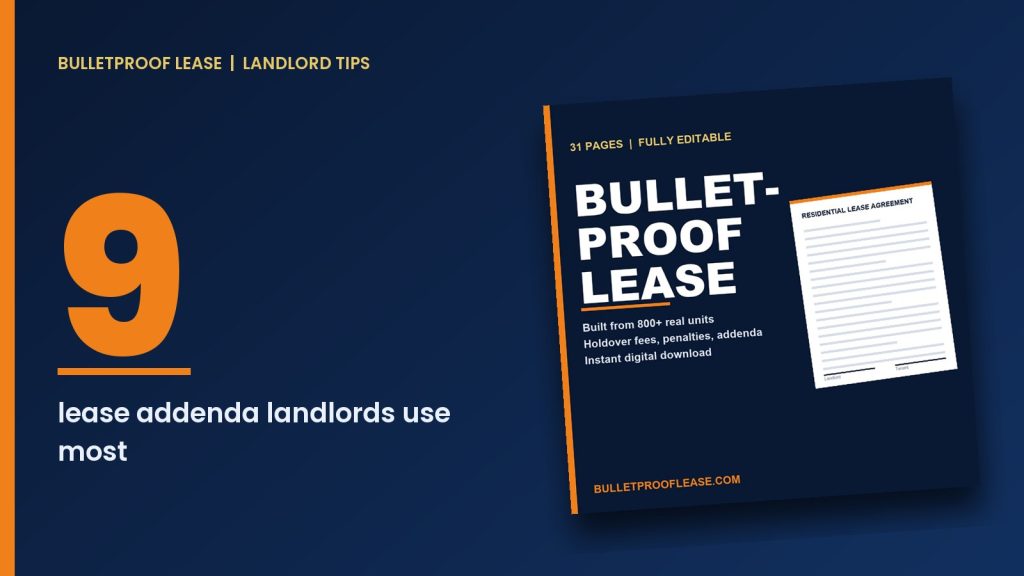
Lease Addendums Every Landlord Needs (and When to Use Them)
Holdover, cleaning, credit, rules, pets, utilities, lead-paint disclosure and late fees: the addenda that prevent arguments, and how to introduce…