
Most evictions don’t fail because the tenant won. They fail because the landlord made a procedural mistake somewhere in the chain — a sloppy lease, a missed notice, an inconsistent enforcement pattern — and the judge has to throw the case out, send the landlord back to start, and the tenant gets another month or two of free rent.
After 800+ class C rentals, plenty of evictions, and watching every kind of mistake other landlords make, here are the six that cost the most time and money. Avoid these six and most evictions go smoothly. Make any one of them and you’re in for a fight.
Mistake 1: Using a Lease That’s Vague on Late Fees
The single most common reason eviction cases stall: the lease’s late-fee language is vague enough that the judge throws out the late fees. Once the late fees are gone, the tenant’s “balance owed” drops, and in some states that means the eviction itself can’t proceed because the rent threshold is no longer met.
Specifically problematic language:
- “A late fee may be assessed” — “may” is discretionary. Judge tosses it.
- “Reasonable late fees” — what’s reasonable? Argument for the lawyer.
- “A flat fee of $50 will be charged” with no specific trigger date or compounding schedule — too easy to dispute timing.
What works: Specific dollar amount + specific trigger date + specific compounding schedule + cap that aligns with state law. Plus the late fee structure has to actually appear in the lease that was signed, not in a separate addendum the tenant never agreed to.
Mistake 2: Sending Friendly Texts Before the Pay-or-Quit Notice
You text the tenant: “Hey, just a friendly reminder rent is late. Let me know what’s going on.”
You think you’re being a reasonable human. The tenant’s attorney sees: “Landlord didn’t treat this seriously, was casual about late rent, didn’t follow lease enforcement, established a pattern of laxity that amends the lease’s late-fee structure.”
If you have a strong lease and a clear late-fee schedule, ENFORCE IT FROM DAY ONE. Send the formal late-rent notice. Apply the fee. Send the pay-or-quit notice when the lease’s grace period is up. Don’t text “no rush” — that text becomes the tenant’s exhibit in court.
Every “friendly” text or call before the pay-or-quit notice is the tenant’s defense. Treat late rent like the lease says to treat late rent. Period.
Mistake 3: Botching the Pay-or-Quit Notice Format
The pay-or-quit notice is statutory. Each state has specific requirements: notice period (3 days, 5 days, 7 days, 14 days — varies), required language (“you are hereby notified…” in some states, specific caption in others), specific delivery method (certified mail vs. in-person vs. posting on the door), specific date format.
One wrong word, one missed delivery method, one off-by-a-day notice period, and the eviction filing gets dismissed. You start over. The tenant gets another month free.
Look up your state’s exact requirements (state landlord-tenant code is the authoritative source, not a blog post) and follow the format precisely. Don’t freelance the pay-or-quit notice.
Mistake 4: Accepting Partial Payment After Filing
Tenant owes $2,800 in rent + late fees. You’ve filed for eviction. Tenant Venmos you $500 with a note saying “more coming.”
You just (in many states) reset the eviction clock by accepting partial payment. The court sees you accepting money and concludes you’re agreeing to a payment arrangement instead of pursuing eviction. Tenant gets to stay, gets another notice, you start over.
The right move: don’t accept partial payment after a pay-or-quit notice has been served unless you’ve explicitly agreed in writing to a payment plan that includes a “this does not waive eviction rights” clause. If they want to give you partial money, send it back or hold it without depositing until you’ve confirmed your state’s rules. This one bites a lot of landlords.
Mistake 5: Showing Up to Court Without the Documentation Chain
Eviction court is paperwork court. The judge isn’t deciding “is this tenant a good person.” The judge is deciding “did the landlord properly document the breach and follow the legal process?”
The documentation chain you need at the hearing:
- The signed lease — original, with both signatures, all addenda
- Rent ledger — showing every payment received, every charge applied, every late fee assessed, in order
- The first late-rent notice — with proof of delivery (delivery receipt, certified mail receipt, photo of posting)
- The pay-or-quit notice — with proof of delivery
- Any written communication with the tenant — texts, emails, voicemails (transcribed)
- Photos of the property condition if damage is part of the case
Show up missing any of those pieces and the case stalls. Show up with all of them and most evictions resolve at the first hearing.
Mistake 6: Using a Property Manager Who Won’t Push the Process
If you use a property manager, vet how they handle late rent before hiring them. The wrong PM hands the lease back to a tenant after a “few days late, no big deal” pattern, then hands you a 4-month problem when you finally find out.
Questions to ask:
- What’s the exact day rent is considered late?
- What day is the first formal late notice sent?
- What day is the pay-or-quit notice triggered?
- How quickly does an eviction filing happen after the pay-or-quit deadline?
- Do they handle eviction filings in-house or do you have to manage it?
If the answers are vague, find a different property manager. The wrong process at the manager level cascades into months of lost rent at the owner level.
The Common Thread
All six mistakes share a root cause: treating eviction as a personal conflict instead of a procedural process. Eviction isn’t about whether you’re a good landlord or whether the tenant is a good person. It’s about whether you have a strong lease, you followed the lease’s enforcement chain, and you documented every step.
The lease is the foundation of all six. The BulletProof Lease was built specifically around the enforcement chain — late-fee schedule, notice triggers, grace periods, pay-or-quit language — so that landlords using it have the procedural backup they need when an eviction actually happens.
For more on the strong-lease basics, see our post on why a strong lease matters. For tenant screening (which is the best way to avoid eviction in the first place), see our tenant screening checklist.
Want a lease document that’s already built around eviction-proof enforcement? Save yourself the months of lost rent.
Get The Lease →Ready to take the next step?
Protect your rent with the 31-page BulletProof Lease, or learn how to buy and run multi-family property in the Landlord Coaching Program.
Join the Coaching: $899Get the Lease: $159
Keep reading

How to Raise Rent and Renew Leases Without Losing Good Tenants
A renewal timeline, a way to set the increase, what to put in the offer and what to do when…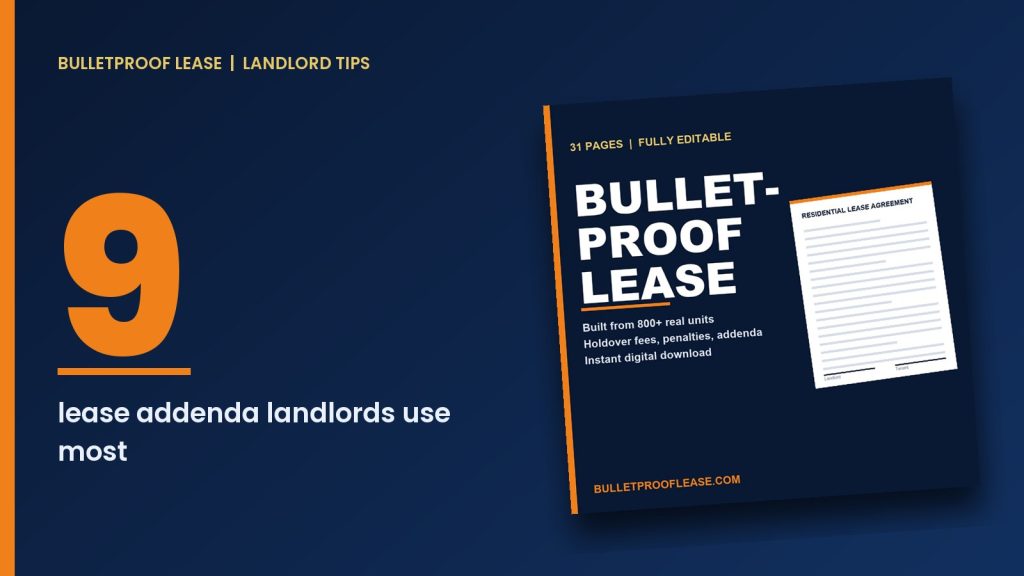
Lease Addendums Every Landlord Needs (and When to Use Them)
Holdover, cleaning, credit, rules, pets, utilities, lead-paint disclosure and late fees: the addenda that prevent arguments, and how to introduce…